What is a Dobson Unit?

A Dobson Unit (DU) is a unit of measurement specifically used to measure the amount of ozone in the Earth’s atmosphere. It represents the thickness of a layer of pure ozone that would be created if all the ozone molecules in a vertical atmospheric column were compressed to standard temperature and pressure (STP) conditions.
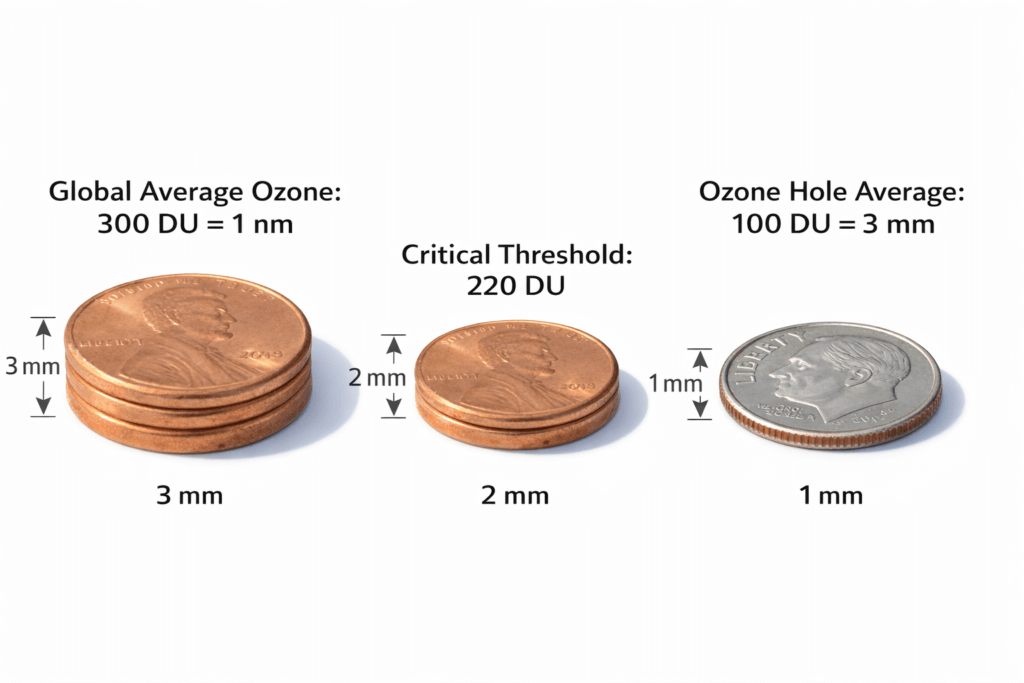
This comparison uses U.S. coins to illustrate the scale of the ozone layer. If compressed to the Earth's surface at standard temperature and pressure, a healthy global average of 300 DU would only be as thick as two pennies (3 mm), while an "ozone hole" of 100 DU would be as thin as a single dime (1 mm).

A side-by-side comparison explaining the Dobson Unit (DU) for measuring ozone. On the left, two stacked copper pennies represent a "Global Average Ozone" of 300 DU, totaling 3 mm in thickness. On the right, a single silver dime represents an "Ozone Hole Average" of 100 DU, measuring 1 mm in thickness. The image demonstrates that even a healthy ozone layer is remarkably thin.
This comparison uses U.S. coins to illustrate the scale of the ozone layer. If compressed to the Earth’s surface at standard temperature and pressure, a healthy global average of 300 DU would only be as thick as two pennies (3 mm), while an “ozone hole” of 100 DU would be as thin as a single dime (1 mm).

One Dobson Unit is equal to a layer of ozone 0.01 millimetres thick at a temperature of 0 degrees Celsius and a pressure of 1 atmosphere. So, a reading of 300 Dobson Units (DU) of ozone signifies that the ozone molecules in that atmospheric column would create a pure ozone layer 3 millimetres thick at STP.

Ozone is not uniformly spread throughout the atmosphere. The Dobson Unit provides a convenient way to express the total amount of ozone in an atmospheric column, even though the ozone isn’t concentrated in a single layer.

Visualizing the Ozone Shield: The vertical structure of Earth's atmosphere. While the majority of our air resides in the troposphere, the vital ozone layer is concentrated in the stratosphere. One Dobson Unit (DU) represents a layer of pure ozone 0.01 mm thick at standard temperature and pressure; if all the ozone in this vertical column were compressed to sea level, it would be only about 3mm thick (300 DU).
Atmospheric Profile and Ozone Concentration: This diagram illustrates the layers of the atmosphere from the Troposphere to the Exosphere. The ‘Ozone Layer’ (found between 15–35 km) is measured in Dobson Units, quantifying the total amount of ozone in a vertical column overhead.

Key Points to Remember about Dobson Unit

  • Dobson Unit (DU) measures total ozone in the atmosphere
  • 1 DU equals 0.01 mm of compressed ozone
  • Normal global value ≈ 300 DU
  • Ozone hole occurs when values fall below 220 DU

How is Ozone Measured?

  • Ozone is measured using:
    • Ground-Based Instruments: Special instruments called Dobson spectrophotometers measure ozone by observing sunlight.
    • Satellites: Satellites orbiting Earth continuously monitor ozone levels across the globe.

The data from these instruments is converted into Dobson Units.

Dobson Unit Scale
Dobson Unit Scale

Dobson Units are named after G. M. B. Dobson, a scientist who developed the first spectrometer specifically designed to measure ozone from the ground. The Dobson ozone spectrophotometer, a widely used instrument, remains in use today worldwide.
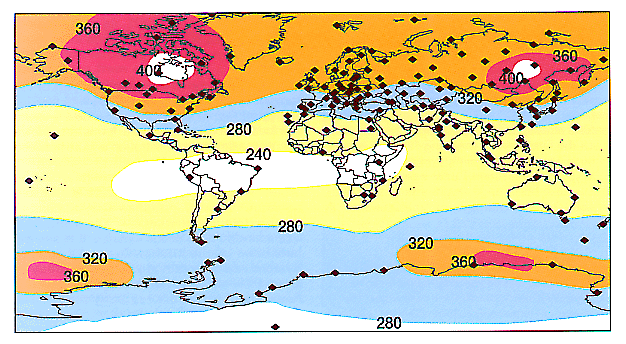
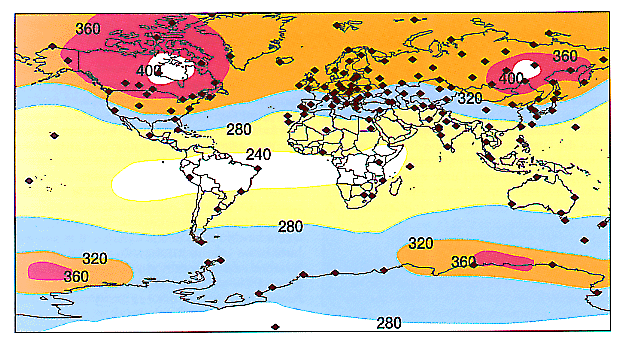
Global Ozone Variability: This map illustrates how Dobson Units (DU) vary by latitude. While the tropics produce the most ozone via solar radiation, large-scale circulation moves it toward the poles. The dots represent the critical ground-based stations that monitor these levels to detect changes in the ozone layer's health.
Mapping the Global Ozone Shield: A look at the GO3OS network stations plotted against global ozone distribution. Notice the distinct gradient: lower ozone concentrations (approx. 250 DU) in the equatorial belt, contrasted with significantly higher concentrations (up to 450 DU) in the mid and high northern latitudes due to atmospheric transport patterns. (Source: NOAA)
error: Content is protected !!
Scroll to Top